Published On: October 29, 2026

Cloud managed services are ongoing IT services in which a specialist provider monitors, maintains, secures and manages a business’s cloud environment. For Australian businesses, this can include infrastructure management, Microsoft Azure administration, Microsoft 365 support, security monitoring, backup management, access controls, performance optimisation and technical assistance. A managed service provider (MSP) takes responsibility for agreed operational tasks, helping internal IT teams reduce routine workloads, manage risks and maintain reliable systems.
Understanding what are cloud managed services means looking beyond basic help desk support. A capable provider combines proactive IT support, cloud monitoring, security management, governance and continuous improvement under a defined service agreement. CloudPoints Consulting Group Pty Ltd recognises the value of aligning cloud operations with business requirements, security obligations and long-term IT plans.
Managed cloud services operate through an ongoing agreement that defines the provider’s responsibilities, service levels, security controls and reporting requirements. The MSP works alongside the business to manage the cloud environment, identify issues and make approved changes.
A typical engagement follows five steps:
1. Assessment and planning: The provider reviews the existing cloud environment, workloads, security settings, business applications and operational requirements.
2. Service configuration: Both parties agree on responsibilities, monitoring tools, escalation procedures, access permissions and service-level targets.
3. Continuous monitoring: The provider tracks system availability, performance indicators, security alerts, backup status and relevant infrastructure events.
4. Incident response and maintenance: The MSP investigates alerts, resolves covered incidents, applies approved updates and escalates issues that require additional authority or specialist support.
5. Reporting and improvement: Regular reviews identify recurring incidents, security gaps, unnecessary expenditure and opportunities to improve cloud operations.
The exact service depends on the contract. Some providers manage only infrastructure and backups, while others oversee cloud security, Microsoft 365 administration, identity management and governance.
For example, an organisation using Microsoft Azure might engage an MSP to monitor virtual machines, review resource utilisation, manage backup policies and investigate security alerts. The provider may also recommend changes to reduce unnecessary cloud expenditure, subject to the organisation’s approval process.
A cloud managed service provider manages the agreed technical and operational responsibilities of a cloud environment. Its work should cover prevention, day-to-day administration, incident handling and ongoing improvement.
Cloud monitoring helps identify problems before they cause significant disruption. Providers monitor agreed systems, services, resource usage and performance indicators to detect unusual activity or emerging faults.
Typical responsibilities include:
Monitoring alone does not guarantee prevention. Its value depends on suitable alert thresholds, reliable escalation processes and staff who can respond promptly.
Cloud security management involves maintaining controls that protect systems, identities, applications and business information. Depending on the agreement, an MSP may manage identity permissions, security configurations, endpoint policies and vulnerability remediation.
Common responsibilities include:
For organisations using Microsoft technologies, Azure managed services and Microsoft managed services may include Microsoft Entra ID administration, Microsoft Defender configuration, Microsoft Intune policies and Microsoft 365 security settings.
The division of responsibility must be explicit. A provider may configure and monitor security controls without accepting responsibility for every security incident or every aspect of regulatory compliance.
An MSP may manage backup schedules, monitor failed jobs, protect backup access and test restoration procedures. These activities help businesses recover from accidental deletion, system failures, ransomware incidents and other disruptions.
A reliable service should define:
Having backups is not enough. Businesses need evidence that their data can be restored within acceptable timeframes.
Managed cloud services also cover routine administration and incident resolution. This may include operating system patching, configuration changes, account management, certificate renewals and troubleshooting cloud-connected applications.
Proactive IT support focuses on identifying and addressing issues before they become recurring disruptions. Reactive support, by contrast, primarily responds after a user reports a problem or a system fails.
Both are necessary. The difference is that a managed service should include planned maintenance and prevention, not just a channel for submitting support requests.
Cloud governance establishes how cloud resources are deployed, accessed, secured and maintained. An MSP can help implement policies for resource ownership, tagging, permissions, approved configurations and change management.
Cost management may include reviewing resource utilisation, identifying idle services, examining storage growth and recommending appropriate pricing or capacity changes. Providers should explain their recommendations and obtain approval for changes that could affect performance, availability or spending.
Regular service reviews should examine incident trends, security findings, service-level performance and outstanding improvement actions. This gives business leaders a clearer view of operational risks and the work required to address them.
Cloud managed services and traditional IT support can overlap, but they differ in scope and operating model.
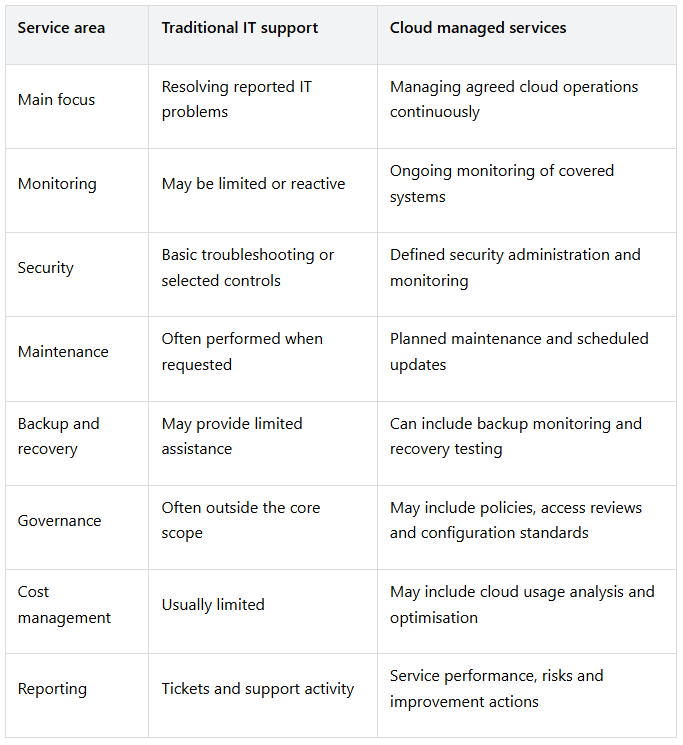
The distinction depends on the provider’s actual service agreement. A traditional IT provider can offer managed cloud services, and an MSP can provide reactive help desk support. The service scope matters more than the label.
A business should consider managed cloud services when it needs consistent cloud administration, security oversight or operational support beyond what its internal team can reasonably deliver.
Common situations include:
Larger organisations with established IT departments can also use an MSP to cover specialist skills, after-hours monitoring or selected cloud platforms. Managed services do not require a business to outsource its entire IT function.
Cloud managed services can be worth the investment when the provider’s responsibilities address genuine operational gaps and the benefits justify the total cost. The decision should consider more than the monthly service fee.
Potential benefits include reduced pressure on internal IT staff, earlier identification of technical issues, consistent maintenance, clearer accountability and access to specialist expertise. The financial value may also come from reducing avoidable outages, improving recovery readiness and identifying unnecessary cloud expenditure.
However, managed services introduce costs and dependencies. Poorly defined contracts, limited visibility, slow escalation or excessive reliance on a provider can create new risks.
Australian businesses should also assess relevant privacy, security and industry obligations. The Australian Privacy Principles may apply to organisations covered by the Privacy Act 1988, while contractual, industry-specific and other regulatory requirements may impose additional controls. Outsourcing IT operations does not automatically transfer the organisation’s legal responsibilities to its MSP.
Before signing an agreement, compare the service fee with the internal resources required to deliver the same work, the cost of specialist tools, after-hours coverage and the likely impact of operational disruption.
Choosing a cloud MSP requires an assessment of technical capability, accountability and service quality. A provider’s marketing claims are less useful than clear commitments and evidence of how the service operates.
Use this checklist during provider evaluations:
For cloud managed services Australia businesses should also examine the provider’s approach to data handling, subcontractors, incident notification and access to information from offshore locations where relevant. Ask for written answers instead of relying solely on verbal assurances.
Pricing varies according to the number of users, cloud resources, supported platforms, security requirements, service hours and contractual scope. Some providers charge per user or device, while others use fixed monthly fees or consumption-based pricing. Request an itemised proposal that identifies exclusions, additional project charges and any third-party licensing costs.
A cloud service provider supplies cloud infrastructure or software, such as computing resources, storage or business applications. An MSP manages agreed aspects of those services for a customer, including administration, monitoring, security configuration and support. One company may perform both roles, but the responsibilities are different.
They can, but cybersecurity coverage varies by contract. Some agreements include security monitoring, identity administration, patching and incident coordination. Others treat advanced threat detection, managed detection and response, penetration testing or incident recovery as separate services. Confirm exactly which controls and response activities are included.
Yes. A co-managed arrangement allows internal IT staff to retain control of business systems, priorities and approvals while the MSP handles agreed technical tasks. For example, internal staff might manage business applications and user requirements while an external provider monitors Azure infrastructure and maintains backup systems.
An MSP can administer Azure resources, monitor infrastructure, manage identity permissions, maintain security configurations and support Microsoft 365 services. The scope may include endpoint management, backup monitoring and access reviews. Responsibilities should be divided clearly between the provider, the business and the underlying technology vendors.
Yes. Small businesses can use managed services to access technical expertise and routine cloud administration without employing specialists for every task. The agreement should match the organisation’s actual requirements so that it does not pay for unnecessary monitoring, tools or support coverage.
Cloud managed services work best when they establish clear ownership, dependable monitoring, practical security controls and measurable service improvements. Australian businesses should evaluate providers on the work they perform, the risks they address and the evidence they supply, rather than choosing solely on price.
A suitable MSP can complement an internal IT team, maintain agreed cloud operations and help leadership make better-informed decisions about security, continuity and expenditure. Businesses comparing managed cloud services should begin by documenting their current environment, recurring issues and service requirements, then assess providers against those priorities.
CloudPoints Consulting Group Pty Ltd can be considered as part of that evaluation for organisations reviewing their cloud consulting and management requirements. To discuss your business needs, contact us to clarify the services required, expected outcomes and responsibilities that should be included in a managed services agreement.
Australia
P: +61 3 9087 8057 E: [email protected]Singapore
P: +65 6990 7890 E: [email protected]